Thursday, November 11, 2010

Customs and Practices of a Man Called Murph

I find myself frequently blaming a man long dead for the seemingly-chaotic happenstance which plagues, oh, pretty much everybody. I refer, of course, to one Edward Murphy.

For posterity, here is the list of "laws" from which i exhume my nuggets of nonchalance (photo-jacked from a poster in the men's room of Zoe's Double Hex Cafe, Manchester, VT):

No good deed goes unpunished.

Leak-proof seals - will.

Self-starters - will not.

Interchangeable parts - won't.

There is always one more bug.

Nature is a mother.

Don't mess with Mrs. Murphy.

50% of everything is crap.

If you're feeling good, don't worry, you'll get over it.

All warranties expire upon payment of invoice.

Where you stand on an issue depends on where you sit.

Never eat prunes when you are famished.

Friends come and go, but enemies accumulate.

If you try to please everybody, nobody will like it.

A short cut is the longest distance between two points.

Anything that can go wrong, will go wrong.

You will always find something in the last place you look.

The chance of a piece of bread falling with the buttered side down is directly proportional to the cost of the carpet.

No matter how long or hard you shop for an item, after you've bought it, it will be on sale somewhere cheaper.

No one's life, liberty, or property are safe while the legislature is in session.

The other line always moves faster.

In order to get a loan, you must first prove you don't need it.

Anything you try to fix will take longer and cost more than you thought.

If you fool around with a thing for very long, you will screw it up.

A $300.00 picture tube will protect a $0.10 fuse by blowing first.

If it jams - force it. If it breaks, it needed replacing anyway.

Any tool dropped while repairing a car will roll underneath to the exact center.

The repairman will never have seen a model quite like your's before.

When a broken appliance is demonstrated for the repairman, it will work perfectly.

A pipe gives a wise man time to think and a fool something to stick in his mouth.

Everybody believes in something - I believe I'll have another drink.

Build a system that even a fool can use and only a fool will use it.

Everyone has a scheme to get rich quick that will not work.

In every hierarchy, each individual rises to his own level of incompetence and then remains there.

You will remember that you forgot to take out the trash when the garbage truck is two doors away.

The race is not always to the swift, nor the battle to the strong, but that's the way to bet.

There's never time to do it right, but there's always time to do it over.

When in doubt, mumble, when in trouble, delegate.

Anything good in life is either illegal, immoral, or fattening.

It is morally wrong to allow suckers to keep their money.

A bird in hand is safer than one overhead.

Murphy's Golden Rule: whoever has the gold makes the rules.

Everything east of the San Andreas fault will eventually plunge into the Atlantic Ocean.

Nature always sides with the hidden flaw.

The light at the end of the tunnel is the headlamp of an oncoming train.

Celibacy is not hereditary.

Never sleep with anyone crazier than yourself.

Beauty is only skin deep, ugly goes to the bone.

To know yourself is the ultimate form of aggression (Freudian Psychology).

Never play leapfrog with a unicorn.

A Smith & Wesson beats four aces.

If everything seems to be going wrong, you obviously don't know what the hell is going on.

If more than one person is responsible for a miscalculation, no one will be at fault.

In case of doubt, make it sound convincing.

Never argue with a fool, people might not know the difference.

Monday, June 7, 2010

Hope for the Hopeless/The Kindness of Strangers


I love PostSecret. For those who aren't familiar, this dude, Frank Warren began in 2004 what he calls a "community art project" which displays the secrets of others. Every Sunday, Frank puts up 20 postcards that were sent to him anonymously, each of which reveals a deep-dark secret from its sender. Some are depressing, some are inspiration, some are funny. Just in the past four years he has received over 300,000 cards.

I first heard about the project not to long after it went live, sometime in my freshman year of college. Over the years, it has provided innumerable instances of true humanity into the landscape of my experience. It has helped me form my Everyone Is Crap theory. It has helped me love people for who they are.

For Frank, he has used his stumbled-upon fame to support The National Hopeline Network and 1.800.SUICIDE. He has created an anonymous, mostly online community of acceptance, honesty, forgiveness, love.

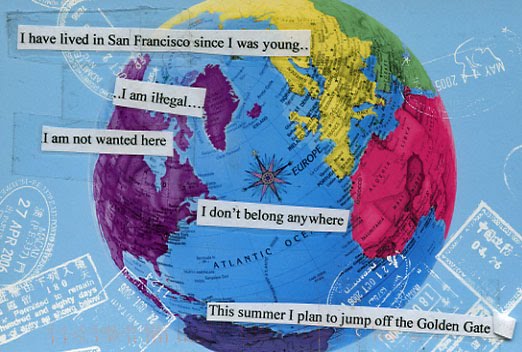
Today, i stumbled upon the postcard above. It yanked at my heart, as i know the pains and struggles of that level of depression. I know, for that person, even send that card must have been amazingly cathartic. I hope it helps him. If not, there's always this:

The Please Don't Jump facebook group is now 26,000 members. It was started the day the secret went upand was over 20k in less than 24 hours. Covering the wall of the group's page are exhortations from randoms strangers saying "come live here. We want you." This sort of support is inspiring, but in the sort of social media sitethat has a Group supporting a pickle who's sole purpose was to have more members than the Nickleback-supporting group. That group had 1.5 million members, apparently.

The Together For Life! facebook group is taking a FAR more active approach to this kid. An anonymous member of the PS community wrote in saying:
"On Sunday the 13th at noon I plan on printing up all the caring comments from facebook, taking them to the Golden Gate Bridge and taping them up all along the walkway."
Lindsey Salazar saw the comment and started an event to garner some further support. So far, 107 people have said they're going to show up and show this random individual how much they love him or her - even though none of them have ever met the anonymous sender.

Hopefully, this story will have an ending we can see. Hopefully, it'll be a happy one. I know that PostSecret has had a huge impact in the short time its been around, but this would be a big win for the kind of awareness that Frank - and everyone who follows PS.com - is hoping to see.

EDIT: Sorry for broken links. Now i can't even find the groups anymore, blarg.

Thursday, April 22, 2010

Orly?

I've recently been thinking on a post i wanted to write about the nature of the experience that is a musical concert. Instead, today's post is going to comment more upon the nature of Art as a whole. You see, Twitter brought to my attention Roger Ebert's recent article delineating why video games are not, and can never be, Art. As a rabid geek, self-described gamer, artist, writer, this assertion rankled with me. The riling nature of his opinions are all the more exacerbated by the fact that, as near as i can tell, Mr. Ebert has played few - if any - video games.

This nest-rattling claim was first made way back in 2005 and has been brought up every now and again ever since, responded to by such names as Tycho & Gabe, Kellee Santiago, my fellow writers at Cracked.com, and many others. The debate has only recently come to my attention, although i've held the Gamer's position for many years now, not even considering the opinions of the general masses, let alone considering them for any length of time.

Many good points are made on both sides. Ebert's big talking point - and the one i have the most difficulty refuting - is that the very interactive nature of a game is in conflict with what his conception of what a piece of art is. This view, i must believe, is generally shared with the non-gaming public; Art is viewed, appreciated, experienced, but not "played". The gamers' usual rebuttal begins with Ebert's admission that he's never seen a video game worth playing. Some simply leave it at that, since it proves his stance, however well thought out, comes from a place of complete ignorance regarding the medium. Many, however, go further into the fray, formulating complex arguments with all the rich design that one would see in the programming of one of their exemplary games. And that is why this fight will never end.

Eventually, all the arguments come down to trying to define what Art is in such a way that their view point falls within its parameters and the other side's doesn't. Obviously, any rhetorical conflict is doomed to idiocy when the parties involved cannot agree upon the definitions which make up the very foundation of any point they might try to make. It seemed Ebert tried to clarify this at least once, in 2007, when he admitted that what he should have said is that, "games could not be high art, as i understand it", but since has become so mired in his single-minded position that the thesis of his most recent article is simply "Video Games Can Never Be Art". This claim is the last nail in the coffin Gamer Good Will.

Let's go a couple steps back and look at why i consider video games to qualify as Art. First off, let me say that i do not believe all games to be Art, just as i don't think all music or movies are Art. Wilco's "Yankee Hotel Foxtrot" is a paramount of modern rock and roll and rewards careful and repeated listens, but i'd get pretty stabby if someone tried to tell me that the new Hannah Montana album is Art. Gus Van Sant's "Elephant", yes. Keenan Wayans' "Scary Movie 2", no. I think its safe to say that all examples do not have to qualify in order to claim that the medium can be considered Art. With that supposition in mind, i formulated my own definition of Art, then talked to my brother (of Good Night, States fame) for his thoughts. His thoughts are thus:

Art is that which is crafted using physical means in an attempt to comment on something metaphysical. Personally, while this definition is rather weighty, i think that very factor is important. Good art should strike you in a way which you cannot precisely define. This point is complimentary to my original thought, namely, that art is anything which is both aesthetically pleasing AND evokes an emotional or visceral response in the perceiver. I'm sure there are as many different views on the concept as there are possible readers of these words.

After our conversation, i found myself unable to reconcile a specific aspect of Steve's definition with my own thoughts. The problem is that my definition leaves out the idea of intentionality. Both my brother and Mr. Ebert agree that Art is created by an artist. This is important.

Very few (if any) games are designed to be works of Art. Hell, not many movies these days are, either, but this does not mean that they are not beautiful.

This is the delineation which i believe is causing such a schism. We, the video game-playing generation, have spent decades sharing a metaphysical experience in the interactive, narrative, sometimes-competitive landscape of a plethora of games, video or otherwise. Be it the sweeping story arc of a beloved Dungeon Master or that one cut scene in Final Fantasy Whatever, we have all be touched by a game we have played in a way that just slightly defies explanation. We have found beauty, and it has changed us.

What makes us such a unified front is that these experiences, while often occurring in the stereotypically dank, isolated caverns of our mother's basement, has been shared by millions of gamers. This effect has cleaved us together, mind and soul, with a bond much akin to that shared by the audience of a momentous event, or the brothers-in-arms of a conflict. We all watched Aeris die. We all dread Water Temples. We all know that the cake is a lie. We all recognize the Konami Code. These experiences make up the shared history of Gamers in a way that is no less meaningful than any other demographic-defining denominator.

And this, dear reader, is why we, the gaming community, are so pissed at Roger Ebert. I think Cracked.com writer Robert Brockway put it very well in the closing paragraph of his defense:

"But why even bother with all of this? Ebert himself wonders: 'Why are gamers so intensely concerned, anyway, that games be defined as art? Bobby Fischer, Michael Jordan and Dick Butkus never said they thought their games were an art form….Why aren’t gamers content to play their games and simply enjoy themselves?' And he’s already answered his own question: 'do we as their consumers become more or less complex, thoughtful, insightful, witty, empathetic, intelligent, philosophical (and so on) by experiencing them?' Anybody who’s ever felt even an inkling of something like that from a game is going to be understandably 'concerned' when you insist that they’re lying."

The aging critic is just lucky he doesn't drop any purples, or there'd be a queue to take a crack at him.

Saturday, April 3, 2010

In Memorium

This summary is not available. Please click here to view the post.

Tuesday, March 30, 2010

A Photocopy of a Photocopy of a Photocopy... of a Love Letter

I sleep poorly.

Those who spend a fair amount of time in my life know that my sleep issues have been pervasive since i was in high school. No matter how tired i am sitting up, doing things, as soon as the lights go out and my head hits the pillow, i am suddenly wide awake. This state will persist for anywhere from 45 minutes to several hours. Because of this, i often find myself staying awake at night until i just can't keep my eyes open any more, trying desperately to spend the least amount of time staring at the ceiling as possible. After such a night, i sleep in, pushing back my daily allotment of waking hours, causing me to fall asleep even later than the night before. Its a vicious cycle which i've been trying to break by various means for as long as i care to remember.

A big part of this issue is i care far too much for Today Me to be able to reliably set up a good sleeping schedule. I sometimes succeed in going to bed at the same time, getting up at the same time, for a week or so, but then something shiny will tempt me into staying up late, i'll sleep in, kablooey.

My mother is reading a novel by Chuck Hogan called Devils in Exile, and she recently read my an excerpt from it. I will do my best here to paraphrase the concepts that were related to me:

Most people are like me, staying up too late to satisfy the desires of Today Me, not particularly caring about the consequences for Tomorrow Me. Unfortunately, Tomorrow Me all too soon becomes Today Me again, cursing out Yesterday Me for making such poor choices.

What i need to start doing is thinking of the best interests of Tomorrow Me. Like i so often put other people's interests ahead of my own, i need to start doing for myself. The really interesting part of this whole idea is that i should be doing just that for the exact same reason i do it for other people.

If you spend your days looking out for Tomorrow You, you will quickly find yourself growing to love Yesterday You. Yesterday You is a good bean. He eats well, letting you feel good today. He goes to sleep on time, allowing you to wake up refreshed today. He got all the boring stuff done, giving you time to do some fun stuff today.

You help other people because you love, respect, accept, and appreciate them. Shouldn't you do all that and more for yourself?

Friday, March 19, 2010

Gretz' Hierarchy of Outcasts

I am part of a certain demographic which doesn't exist outside of the etherwebs. In perfect illustration of this, if you have no idea what the "etherwebs" are, you're not part of this demographic.

I am a geek (duh). I spend a fair amount of time fraternizing with real-live-actual-no-they-don't-live-in-Canada-like-that-one-kid's-girlfriend people solely through the medium of the internet. In doing so, i have my ear to the ground on a lot of trends, fads, colloquialisms, styles, interests, dislikes, etc that ONLY EXIST online. As such, this sphere of knowledge both separates me from the masses and cleaves me irrevocably to a community that the aforementioned masses probably have no idea exists.

This is what qualifies me as a member of what i like to call "the fringe". I admit, its a term that makes more sense in the high school society in which i coined it, but i like it, so it stays. This post will now attempt to categorize them.

1. The NERD
The nerd is possibly more common than one might think, easily masquerading as a normal person throughout their day-to-day lives. Nerds are recognized for their love of a particular field or interest that generally is not found very interesting by the world at large. Whether its math, linguistics, entomology, or what have you, the nerd's passion lies outside what you or i may think of as interesting. Nerds are the scientists of the outcasts; they love to learn, love to study, simply for the sake of the scholastic thrill. This differentiates them from the other outcasts in that they visit the spheres that make up their passion, but try not to live there. Nerds can sometimes become so engrossed in whatever it is that they love that they may forget about such social conventions as Style and Hygiene, but its rare. Nerds tend to be too smart for that.

2. The GEEK
I am a geek. Geeks are a little more easily recognized than nerds, and are becoming more and more prevalent every day. This is simply because the field or interest that geeks are passionate about are generally more accepted - or at least more common - than the nerds'. "Computer Geek" is so common a term at this point that it is almost universally recognized. And this is the important point that sets the geek apart from the rest:

There's a million different kinds of geeks.

"Wait!" i can hear you saying, "if there're so many different kinds, what is their common denominator? What makes a geek a geek?" Ok, maybe you aren't saying that, but i'm writing this, so deal. The key factor in a geek is that, while a nerd studies their sphere of interest, visits it to learn more about its intricacies, a geek lives there. The difference is a subtle one, i admit, but important. Geeks usually like to be called nerds (although they might be anyway; you can be both).

The hallmark of a geek vs. a nerd is that geeks tend to be much more socially advanced than nerds. There's a reason the term "geek chic" exists (besides the rhyme). Unfortunately, this leads to a lot more closet geeks than i would like, but it also lets them be accepted members of society, so i gotta let it slide.

3. The DORK
Nobody likes dorks. Not even the nerds or the geeks. The shortcoming of the dork is that, while they may share an interest with a nerd or a geek, they become so absorbed in it that they forsake all else for its sake. They are the ones who gladly sacrifice human interaction for computer. They are the ones who are so engrossed in their trading card collection that they forget to shower. They are what geeks and nerds become when they slide too far away from the anchoring hold of Friends and Family. Also, they're known to bite.

CONCLUSION
Nerds are usually very smart, but can be kind of airheady. They love their chosen interest to the point where they can sometimes let minor things slide. This interest is usually very particular and not often very popular.
Geeks are also often smart, but generally more gregarious. They love their interest, but then, so do a lot of other people. This larger community of like-minded people promotes healthy social skills, sometimes to the point of developing the now almost-common Cool Geek.
No one likes dorks. Sorry, dorks. Go take a shower and call up that friend you yelled at for messing up their klingon conjugations. Come back to the Light Side.

Tuesday, March 9, 2010

Or Is It Too Late?

As i fearfully approach the age that puts me closer to 30 than to 20, i find i am increasingly aware of just how little my current life resembles what i had hoped it would. Add to this the fact that i now know almost as little about what i want to be when i grow up as when that question was first posed to me and it leaves a horrible, smirking demon-monkey clinging to my back, picking nits of Hope and Positive Feelings out of my hair.

"Self, what the hell were you expecting?" i sometimes ask myself. When i was in high school, if i had tried to imagine what my life would look like right now, i probably would have said that i'd hope to be living on my own, working in some field in psychology or at least in school for it, engaged or married, content. Currently, i am none of those things, and at this point, don't even know what i want to be doing When I Grow Up.

Do i want to write? (yes). Do i want to act? Do i want to design, counsel, program? Then, after picking one (or two), i have to decide on the particulars inherent to each profession. You can't just go to a company and say, "i want to program for you". You have to have a specific area picked out and then you have to go to some kind of school to get a piece of paper that says you know how to do it. Then, maybe the company will decide to hire you. And only after a few years of working in that chosen field will you realize whether or not you want to be doing that in the first place.

Hoo boy. That amount of time just sounds to me like a lot of dollar signs i don't have. Unfortunately for me, i only spent two years in school, dropping out for reasons i won't get into here. I saved myself the misfortune of going into debt for a major it turned out i didn't care much for, but here i am, two years later, with no degree. This severely limits my job opportunities, and so, my ability to spend money to figure out what i want to be doing.

Malcolm Gladwell, in his book Outliers details three specific factors in jobs that people describe as "satisfying." These are Autonomy, Complexity, and Connection between effort & reward. These are the things i want in a vocation. Any less, and i am sure i will eventually go mad.

My question is, will i be sane by the time i attain this mythical job?